Carbon Dioxide Therapy
The Other Half of Oxygen Physiology Oxygen Delivery, , the , Respiration, Flow, Movement, and the Therapeutic Potential of CO₂
Therapeutic Love Holistic Wellness Collective
Introduction: CO₂ Is More Than A Waste Gas
When most people think about breathing, oxygen receives nearly all of the attention.
We inhale oxygen. Our lungs transfer it into the blood. carries it through the circulation. Our use oxygen in cellular metabolism. Without oxygen, life rapidly becomes impossible.
Carbon dioxide, by comparison, is commonly described as something we simply need to get rid of.
That description is incomplete.
Carbon dioxide is certainly produced as a consequence of metabolism and must be continuously eliminated through respiration. Excessive accumulation of CO₂ is dangerous. But CO₂ is also deeply involved in acid-base regulation, respiratory drive, vascular tone, cerebral blood flow, 's affinity for oxygen, and therefore the actual delivery of oxygen from the bloodstream into metabolically active tissues.
Oxygen and carbon dioxide should not be understood simply as "good gas" and "waste gas."
They participate in an interconnected respiratory system.
One gas is central to oxygenating the blood.
The other helps influence where, when, and how readily that oxygen becomes available to tissue.
This relationship is beautifully demonstrated by one of the foundational mechanisms of respiratory physiology: the Bohr effect.
The describes the reduction in 's affinity for oxygen that occurs as CO₂ rises and/or local pH falls. In metabolically active tissue, where carbon dioxide and hydrogen-ion concentrations tend to be higher, more readily releases its oxygen.
That means oxygen delivery cannot be understood by looking only at oxygen saturation.
Getting oxygen onto hemoglobin is only one part of the story.
Getting oxygen off hemoglobin and into tissue is another.
That distinction forms the basis of the Therapeutic Love interest in CO₂.
Oxygen Loading Is Not The Same As Oxygen Delivery
A useful analogy is to imagine as a fleet of delivery trucks.
The lungs are the distribution warehouse.
Oxygen is the medicine being loaded onto the trucks.
carries that cargo through the circulatory system.
But a fully loaded delivery truck has accomplished very little if it never unloads its cargo.
Likewise, blood can contain abundant oxygen while the physiology of local tissues determines how readily that oxygen leaves and becomes available for cellular use.
The analogy is intentionally simplified because oxygen transport involves several mechanisms. Oxygen travels primarily bound to under ordinary conditions, while some oxygen is dissolved directly in plasma. Under conditions, the amount of dissolved oxygen can rise dramatically.
Nevertheless, the fundamental point remains:
oxygen availability in the blood and oxygen delivery to tissue are related but different physiological events.
The oxygen- dissociation curve helps describe this relationship.
When conditions shift the curve to the right, 's affinity for oxygen decreases and oxygen can be released more readily.
Among the factors producing this rightward shift are:
- increased CO₂,
- increased hydrogen-ion concentration,
- decreased pH,
- increased temperature,
- and increased 2,3-DPG.
The CO₂/pH component is the Bohr effect.
This gives us a different way of thinking about oxygen therapy.
Instead of asking only:
"How much oxygen can we put into the body?"
we can also ask:
"What conditions influence how that oxygen is distributed and released?"
The Bohr Effect: Where Oxygen Meets Carbon Dioxide
Imagine a working muscle.
Its cells are metabolically active. They consume oxygen and generate carbon dioxide.
As local CO₂ increases, some of it reacts with water through carbonic anhydrase:
CO₂ + H₂O ⇌ H₂CO₃ ⇌ H⁺ + HCO₃⁻
This increases hydrogen-ion concentration and lowers local pH.
Those changing conditions alter 's structure and decrease its affinity for oxygen.
therefore becomes more willing to release its oxygen.
This is elegant biological feedback.
The tissue doing more metabolic work generates more CO₂.
The environment surrounding that tissue changes.
responds to that environment by releasing oxygen more readily.
In other words, metabolism itself helps create a chemical signal associated with oxygen unloading.
This is one reason describing carbon dioxide simply as "waste" misses an important part of respiratory physiology.
CO₂ participates in the distribution system.
Oxygen And CO₂ As Complementary Regulators
Oxygen and carbon dioxide also exert powerful effects on blood vessels.
The relationship is complex and differs across tissues, but the cerebral circulation provides an especially striking example.
Elevated arterial CO₂——is a potent cerebral vasodilatory stimulus. Lowering CO₂ through excessive ventilation can do the opposite, producing cerebral and reducing cerebral blood flow.
Hyperoxia can also produce , including cerebral .
During oxygen therapy, this does not necessarily mean that tissue receives less oxygen. conditions greatly increase dissolved oxygen in plasma, so substantial oxygen delivery can continue despite reductions in blood flow.
This requires an important distinction.
It would be too simple to say:
"Oxygen closes blood vessels and CO₂ opens them."
Physiology is more sophisticated than that.
But as a broad educational model—particularly in the brain—there is a real reciprocal relationship worth understanding:
hyperoxia can favor vasoconstriction, while increasing arterial CO₂ is a powerful vasodilatory stimulus.
That reciprocal vascular behavior becomes particularly interesting when CO₂ is changed rhythmically rather than held continuously at an elevated level.
And that leads directly into emerging research on vasomotion and the glymphatic system.
Vasomotion: The Blood Vessel As A Pump
Blood vessels are not simply rigid pipes.
Their diameter changes continuously.
Vascular smooth muscle contracts and relaxes in response to metabolic, neural, chemical, mechanical, and endothelial signals.
When vessels rhythmically constrict and dilate, this behavior is called vasomotion.
That movement matters because the vascular system exists within and beside other fluid compartments.
In the brain, arteries and their surrounding spaces interact with cerebrospinal fluid and interstitial fluid.
Researchers have therefore become increasingly interested in whether vascular oscillations can help drive fluid movement through pathways involved in clearing metabolic byproducts from the brain.
This is where the emerging science becomes especially relevant.
The Glymphatic System: The Brain's Fluid-Clearance Network
The brain does not have a conventional network distributed throughout its tissue in the same manner as many other organs.
Instead, fluid exchange involving cerebrospinal fluid, interstitial fluid, perivascular spaces and downstream drainage participates in removing metabolic byproducts from brain tissue.
This has become broadly known as the glymphatic system.
Among the substances relevant to this research are proteins such as:
amyloid-beta, tau, and alpha-synuclein.
Abnormal accumulation of these proteins is associated with neurodegenerative disorders. Amyloid-beta and tau are strongly associated with Alzheimer's disease pathology, while alpha-synuclein aggregation is a hallmark of Parkinson's disease.
That does not mean CO₂ therapy has been demonstrated to prevent or treat Alzheimer's or Parkinson's disease.
But it explains why scientists are interested in mechanisms capable of influencing brain-fluid movement.
And in 2025, researchers published a particularly relevant experiment.
The University Of New Mexico Research
Researchers associated with the University of New Mexico School of Medicine, the Mind Research Network and the New Mexico Veterans Affairs Health Care System studied intermittent in healthy older adults and people with Parkinson's disease.
The paper was published in npj Parkinson's Disease.
Rather than simply maintaining elevated CO₂, researchers used intermittent CO₂ exposure—alternating periods of higher and lower CO₂.
The result was rhythmic vascular movement.
The researchers reported that intermittent produced vasomotion-associated cerebrospinal-fluid inflow in both healthy participants and participants with Parkinson's disease.
The response was reduced in the Parkinson's group relative to healthy controls.
The University of New Mexico subsequently described the research as an exploration of whether intentionally changing blood CO₂ through rhythmic exposure or controlled breathing could enhance function.
This distinction is critical.
The research does not prove:
"CO₂ removes Parkinson's or Alzheimer's toxins."
A more scientifically accurate statement is:
Intermittent hypercapnia has been shown to induce vasomotion-associated CSF inflow, providing a plausible mechanism through which rhythmic vascular changes could influence glymphatic transport.
Because the system participates in clearing metabolic byproducts—including proteins associated with neurodegeneration—this represents an intriguing area of ongoing research.
That is a much stronger statement scientifically because it says exactly what has been demonstrated without extending the evidence beyond its boundaries.
Why Rhythm May Matter More Than Simply "More CO₂"
This research suggests another important idea.
The interesting variable may not simply be the amount of CO₂.
It may be the change in CO₂.
Increase.
Decrease.
.
Return toward baseline.
Increase again.
Return again.
That creates vascular oscillation.
Rather than imagining CO₂ therapy simply as holding blood vessels open, a more useful model may be:
rhythmic CO₂ exposure can act as a vascular stimulus capable of producing repeated changes in vessel diameter.
This is much closer to a pump.
The University of New Mexico investigators specifically describe as rhythmic constriction and dilation of blood vessels and investigated whether those oscillations can help drive cerebrospinal fluid movement.
This gives scientific grounding to something Therapeutic Love has been exploring conceptually:
CO₂ training may be interesting not simply because of vasodilation, but because controlled oscillation between physiological states may create movement.
Breathing Creates Another Pump
There is another mechanism operating simultaneously.
Breathing itself moves fluid.
When the descends during inhalation, pressures within the thoracic and abdominal cavities change.
Those pressure gradients influence venous return, cerebrospinal-fluid movement and circulation.
Real-time MRI research has demonstrated substantial respiratory influences on CSF movement.
Forced inspiration can generate upward CSF movement along the spinal canal. Other studies have found that deep breathing couples venous and CSF dynamics, probably through changes in intrathoracic and intra-abdominal pressures.
More recent research has likewise found that deep breathing increases CSF displacement and net flow, with displacement and inhalation duration among the respiratory variables most strongly associated with those changes.
Respiration also interacts with movement.
The thoracic duct is the major vessel returning lymph toward the venous circulation.
return is assisted by several mechanisms, including intrinsic contractions, skeletal-muscle activity, pressure gradients and respiration. A 2026 systematic review concluded that respiration influences thoracic-duct flow and/or pressure in most of the human and animal studies reviewed, while also emphasizing that the evidence remains heterogeneous.
Therefore, deep diaphragmatic breathing creates something mechanically significant.
The is not merely pulling air into the lungs.
It is changing pressure throughout the thoracic and abdominal cavities.
Those changing pressures interact with fluid systems throughout the body.
The Concept Of A Double Pump
This leads to what Therapeutic Love describes as a double-pump hypothesis.
One pump is vascular.
Changing CO₂ influences vascular tone.
When CO₂ rises and falls rhythmically, vessels can dilate and return toward baseline, producing .
The second pump is mechanical.
Deep diaphragmatic respiration changes pressure within the chest and abdomen and influences venous, CSF and movement.
The two mechanisms can occur simultaneously:
vascular oscillation + respiratory pressure oscillation.
The result is not merely "taking deeper breaths."
It is a coordinated series of pressure, vascular, respiratory and autonomic changes occurring throughout the organism.
The scientific literature supports the individual components of this model.
Research supports:
CO₂-dependent cerebrovascular reactivity.
Intermittent producing -associated CSF inflow.
Respiratory modulation of CSF movement.
Respiratory involvement in dynamics.
What remains to be established is how much these mechanisms can be intentionally combined into a clinically useful therapeutic intervention.
That is where the model moves from established physiology into an active research question.
The Therapeutic Love HBOT → CO₂ Working Model
Within the Therapeutic Love stack, one area of particular interest is the relationship between oxygen therapy and subsequent CO₂-based physiological training.
The hypothesis begins with oxygen loading.
oxygen increases the partial pressure of oxygen dramatically and increases the amount of oxygen physically dissolved in plasma.
This creates an unusually oxygen-rich circulatory environment.
Hyperoxia can simultaneously produce .
The Therapeutic Love question then becomes:
What happens if oxygen loading is followed by a carefully controlled vascular and respiratory stimulus?
This is where CO₂ becomes interesting.
CO₂ influences cerebral vascular dilation.
CO₂ and associated changes in pH influence 's affinity for oxygen through the .
Respiration simultaneously creates mechanical pressure changes affecting fluid movement.
Intermittent CO₂ can generate .
Conceptually, therefore, the sequence can be represented as:
Oxygen loading → vascular/metabolic transition → CO₂-responsive vasomotion → oxygen unloading physiology + respiratory fluid movement.
I regard this as a Therapeutic Love working hypothesis and an exploratory framework. Its individual physiological pieces deserve to be studied alongside the wisdom carried through breath-centered healing traditions.
Comparative clinical research has not yet answered whether following HBOT with inhaled CO₂ improves outcomes beyond HBOT alone. That unanswered question does not erase the practice or the observations behind it; it tells us what to measure carefully.
Several components of the hypothesis are independently grounded in established physiology. I hold both forms of knowledge here: what has been carried through experience, and what modern research has measured so far.
The Medicine-Truck Analogy
For teaching purposes, we can return to the delivery-truck analogy.
oxygen fills the delivery system with oxygen.
Imagine sending thousands of medicine trucks onto the highway.
That does not automatically determine where every truck unloads.
The local tissue environment still matters.
Metabolically active tissues generate CO₂ and hydrogen ions.
Those local conditions reduce 's affinity for oxygen through the .
The trucks become more willing to unload their cargo where metabolic activity has changed the local environment.
The analogy should not be interpreted literally: oxygen also substantially increases dissolved plasma oxygen, which does not depend on unloading in the same way.
Nevertheless, the metaphor teaches something extremely important:
oxygen loading and tissue oxygen delivery are not identical concepts.
The body regulates both.
CO₂ And The Exterior Of The Body
The therapeutic interest in carbon dioxide is not limited to inhalation.
CO₂ has also been investigated through transcutaneous therapy, CO₂ baths and carboxytherapy.
Historically, carbonated mineral baths have been used in European balneotherapy.
Research on CO₂ baths has reported increases in cutaneous blood flow and has investigated potential applications in cardiovascular and peripheral circulatory conditions.
CO₂ therapy has also received modern clinical attention.
A randomized clinical trial involving diabetic chronic wounds reported substantially greater wound healing with medical-grade CO₂ therapy than with the comparison intervention.
More recent randomized trials have continued investigating CO₂ for difficult-to-heal diabetic foot ulcers and reported improvements in wound healing and tissue oxygenation when CO₂ treatment was added to standard care.
CO₂ has also been investigated dermatologically through topical carboxytherapy.
Early controlled studies suggest possible effects on skin recovery following fractional laser treatment, although sample sizes have been small and larger trials are needed.
This reinforces an important concept:
carbon dioxide is biologically active whether we are discussing internal respiratory physiology or certain forms of controlled external application.
The mechanism and evidence differ according to the method of administration, so these therapies should not all be treated as interchangeable.
But collectively they challenge the idea that CO₂ is physiologically interesting only as something the lungs eliminate.
CO₂, The Autonomic Nervous System And Adaptability
Another major component of CO₂ training is the nervous system.
Rising CO₂ is one of the strongest respiratory signals the body experiences.
continuously monitor changes associated with CO₂ and pH.
When CO₂ rises substantially, ventilation increases.
At sufficiently high levels, the experience can become intensely uncomfortable and can produce headache, dyspnea, dizziness, cardiovascular changes, anxiety-like sensations and ultimately serious toxicity.
This is precisely why controlled CO₂ exposure should never be reduced to the idea that "CO₂ is natural, therefore more is better."
It is not.
CO₂ is biologically powerful.
That power is what makes it scientifically interesting and what makes uncontrolled exposure potentially dangerous.
Experimental human research has also demonstrated that can alter heart-rate variability and , showing that changing CO₂ interacts with cardiovascular/autonomic regulation.
From a training perspective, this raises another question:
Can carefully controlled respiratory challenges train adaptability rather than simply produce relaxation?
The objective would not necessarily be to remain continuously.
Healthy physiology requires the ability to change state.
Activate.
Respond.
Recover.
Mobilize.
Downshift.
A resilient nervous system is not one that never experiences activation.
It is one capable of moving appropriately between physiological states and returning toward baseline.
CO₂ tolerance training can therefore be conceptualized as an exploration of physiological adaptability.
But the distinction between breathing practices that modestly change endogenous CO₂ and deliberately inhaling concentrated CO₂ is crucial.
They are not equivalent interventions.
Vascular And Autonomic Conditioning: A Working Question
What interests me through Therapeutic Love is not permanent relaxation. activation and recovery both matter. I want to investigate whether comfortable, controlled respiratory changes followed by recovery can help us understand how flexibly the body moves between physiological states. I call this a vascular and autonomic conditioning hypothesis, not an established therapy.
CO₂ affects blood chemistry, respiratory drive, and vascular tone. Higher CO₂ and lower pH generally make release oxygen more readily through the , but oxygen delivery still depends on blood flow, oxygen saturation, , and the tissue's demand. Cerebral blood vessels respond strongly to arterial CO₂; the fingers and other peripheral vessels also respond to temperature, signaling, endothelial factors, and blood pressure. I cannot infer improved digital circulation from a change in cerebral blood flow.
One breathing pattern I have considered is an approximately 35-second period of active breathing followed by a 35-second pause. This is a research question, not a practice recommendation. Depending on the depth and rate of breathing, the active phase might lower CO₂ and the pause might allow it to rise. I cannot assume that this produces a predictable alternating vascular response. Extended breath holds, deliberate , inhaled CO₂, and combining breathing pauses with electrical stimulation should not be tried without appropriate clinical oversight. They can be especially risky for people prone to fainting, low blood pressure, or cardiovascular problems.
practices, such as comfortable slow rhythmic breathing, may influence heart-rate variability through and the . I would ask whether a person returns toward their own baseline after a respiratory challenge, not assume that a slower heart rate proves dominance. Measuring breathing, end-tidal CO₂, heart rate, , blood pressure, and recovery time together would help separate the physiological responses from what we think is happening.
I am also curious whether theta-range change perceived discomfort or attention during recovery. Sound is a signal to the nervous system, and I want to know what this exact frequency is saying during recovery. EEG and let us watch that response directly. stimulation is another way of speaking to the vagus. I'd explore auditory and electrical signals on their own first, then together, watching what each one does and keeping safety in mind.
Raynaud's offers a way to ask a more specific question: do changes in breathing or recovery correlate with digital temperature, blood flow, episode frequency, and symptom severity? I would establish a baseline, study comfortable breathing, coherence practices, sound, and stimulation separately, and only then examine combinations under suitable monitoring. A change in the brain's circulation or in a person's sense of calm would not on its own demonstrate an improvement in Raynaud's.
Why Breath Holds May Feel Different From Inhaled CO₂
This distinction becomes particularly interesting in the context of a personal observation made during Therapeutic Love experimentation.
Breath holding raises endogenous CO₂ progressively.
But breathing a CO₂-containing gas changes inspired CO₂ directly and can increase arterial CO₂ much more rapidly.
The resulting rate of change, airway exposure, chemoreceptor response, ventilatory response and autonomic response can therefore differ considerably.
That means:
a breath hold and externally administered CO₂ should not be expected to produce identical sensations or physiological responses simply because both can increase CO₂.
This distinction may help explain one of the most interesting observations in this exploration: the nasal response.
A Personal Sinus Observation
During recovery from a significant sinus episode, I experimented with a brief CO₂ exposure and noticed a rapid change in pressure and nasal airflow.
Later, during fall conditions when pollen, residual or other environmental factors periodically left my nasal passages obstructed, I noticed the phenomenon repeatedly.
A short exposure was followed almost immediately by the sensation that my nasal passages opened.
I could breathe through my nose again.
Several minutes later the congestion could return.
The observation was therefore not that CO₂ "cured" the underlying inflammatory condition.
The interesting feature was the speed and reversibility of the response.
Something appeared to be changing very rapidly.
That raised a question:
Was CO₂ acting directly on the nasal epithelial/mucosal tissues, or was the effect being mediated systemically through blood gases, vascular tone, autonomic reflexes or some combination of these mechanisms?
There is actually published evidence remarkably relevant to this observation.
CO₂ And Nasal Airway Resistance
A human experiment published in 1979 examined nasal airway resistance during and .
The investigators found that produced a significant decrease in nasal airway resistance, and the reduction was proportional to inspired CO₂ partial pressure over the range studied.
In plain language:
increasing inspired CO₂ made the nasal airway measurably less resistant to airflow.
That observation closely resembles the subjective experience described above.
But the mechanism becomes even more interesting.
Animal experiments subsequently examined whether the effect was caused simply by CO₂ contacting nasal tissues.
Those experiments suggested that could decrease nasal airway resistance through reflex physiological mechanisms, including neural pathways. Direct exposure of the nose alone did not reproduce every vascular effect seen when CO₂ altered the animal's systemic respiratory physiology.
Therefore, the present evidence does not justify concluding:
"CO₂ touches the sinus epithelium and directly dilates it."
The physiology may actually be more complex.
The rapid opening could involve some combination of:
systemic hypercapnia, chemoreceptor activation, autonomic reflexes, changes in the capacitance vessels of the nasal mucosa, vascular responses, and possibly local airway effects.
And there is an important apparent paradox here.
CO₂ is a powerful vasodilator in the cerebral circulation.
Yet opening the nasal airway can involve reduction of engorgement in the highly vascular nasal mucosa, meaning that "CO₂ causes everywhere" cannot explain the nasal observation by itself.
Different vascular beds respond differently.
That makes the nasal response more—not less—interesting.
Why Breath Holding May Not Reproduce The Nasal Effect
The inability to reproduce the same immediate nasal opening with breath holds provides another useful clue.
It does not prove a direct epithelial mechanism.
Several variables differ simultaneously.
During a breath hold:
CO₂ rises gradually.
Oxygen falls gradually.
There is no inspired CO₂ passing through the upper airway.
There is no continuing respiratory movement.
Intrathoracic pressure behavior differs.
Chemoreceptor activation evolves differently.
The rate of change in arterial CO₂ differs.
During inhalation of a CO₂-containing mixture, by contrast, inspired CO₂ rises immediately while breathing continues.
Therefore, at least four hypotheses remain plausible:
1. A systemic blood-gas effect.
The externally supplied CO₂ may increase arterial CO₂ rapidly enough to produce a stronger reflex response than the particular breath hold being compared.
2. An autonomic reflex.
Chemoreceptor activation may change control of nasal vascular tissue and thereby decrease airway resistance.
3. A local upper-airway contribution.
Direct exposure of nasal mucosa or sensory nerves may contribute to the sensation or physiological response.
4. A combined mechanism.
The most realistic explanation may involve both local and systemic pathways.
At present, the observation should be treated as an experimentally interesting physiological response rather than proof of a particular mechanism.
The Nose Is A Vascular Organ
Understanding nasal congestion also helps clarify the observation.
The nasal passages contain highly vascular tissue.
Airway caliber can change quickly as this vascular tissue fills or empties.
That is why nasal resistance can change dramatically over short periods without any physical mucus plug being removed.
The normal nasal cycle itself demonstrates this phenomenon: autonomic regulation changes vascular engorgement between the two sides of the nose over time.
Consequently, an almost instantaneous improvement in airflow does not necessarily mean or infection has disappeared.
It can simply mean that the vascular state of the nasal tissue has changed.
The fact that congestion can return minutes later actually supports the possibility of a transient vascular/autonomic mechanism.
CO₂ And Heart-Rate Variability
The cardiovascular response adds another layer.
Heart-rate variability, or , describes variations in the time interval between successive heartbeats.
Greater or lesser cannot simply be interpreted as "good" or "bad" without context.
changes with respiration, posture, activity, autonomic state, age and many other factors.
Experimental 5% CO₂ exposure has been shown to change components of and .
That means CO₂ training creates more than a respiratory challenge.
It interacts with a coordinated system involving:
respiration, blood gases, blood pressure, vascular tone, chemoreflexes, heart rhythm and autonomic regulation.
From the Therapeutic Love perspective, the desired quality is not simply maximum .
It is adaptability.
Can physiology respond appropriately to a challenge?
Can it change states?
Can it recover?
Can it tolerate changing internal conditions without disproportionate alarm?
Those questions may ultimately be more meaningful than a single number.
CO₂ Tolerance As Training
Training changes physiology.
Exercise is stressful.
Cold exposure is stressful.
Heat is stressful.
Altitude is stressful.
Breath holding is stressful.
The adaptive response depends on dose, individual physiology, recovery and repetition.
CO₂ tolerance also changes with respiratory training.
Someone unfamiliar with elevated CO₂ may experience an intense air-hunger response relatively quickly.
With certain forms of respiratory training, perception and tolerance can change.
But increased subjective tolerance should never be confused with immunity to CO₂ toxicity.
A trained person can feel calm while undergoing a physiologically significant exposure.
Comfort is not a gas monitor.
This becomes particularly important when discussing externally supplied CO₂.
A Critical Safety Distinction
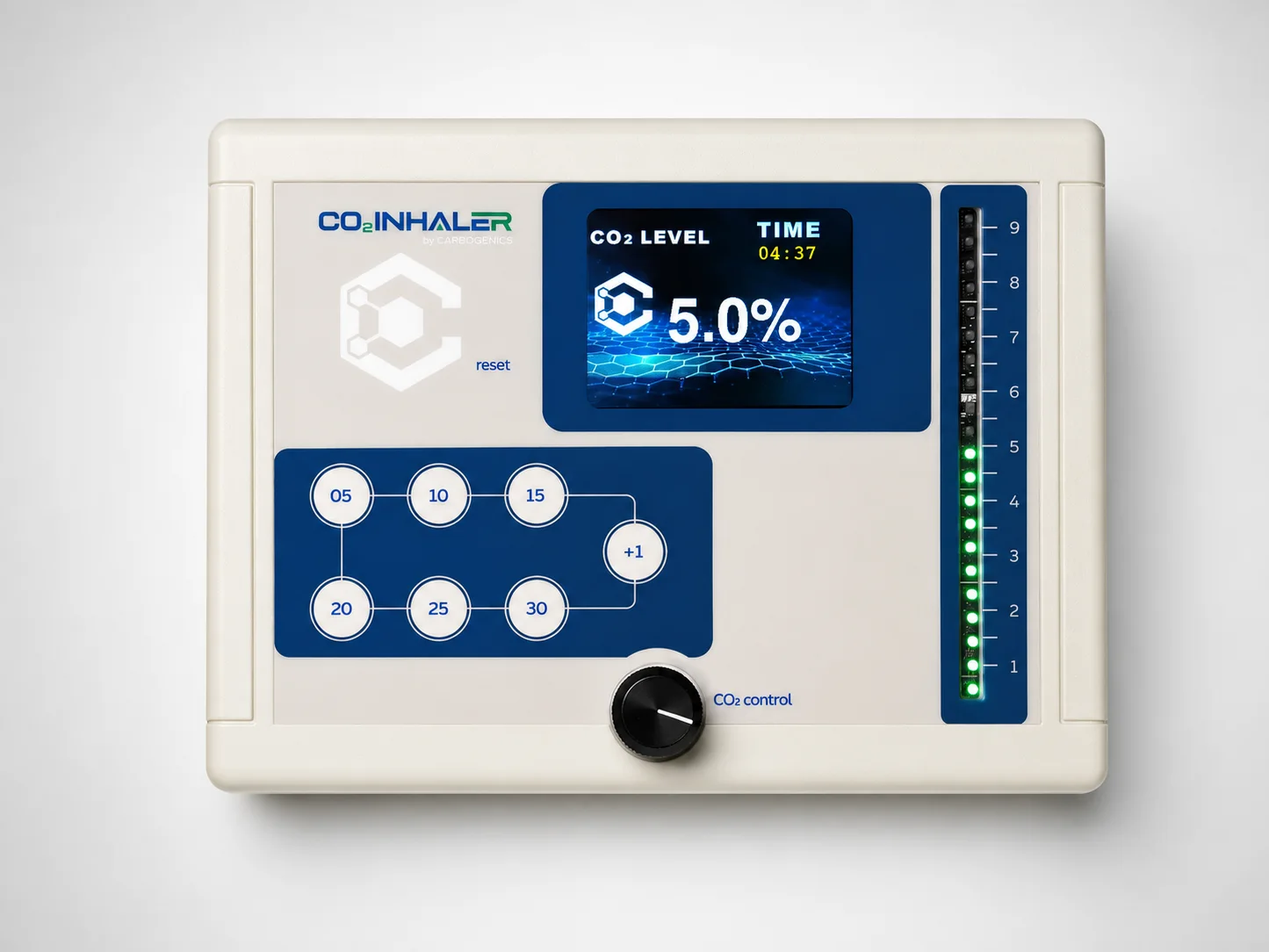
Five-percent CO₂ equals approximately 50,000 parts per million.
That concentration should not casually be described as safe for unsupervised inhalation.
NIOSH lists a carbon-dioxide IDLH—Immediately Dangerous to Life or Health—concentration of 40,000 ppm, or 4%, and a short-term occupational exposure limit of 30,000 ppm, or 3%. These occupational standards are not identical to controlled medical research protocols, but they demonstrate why concentrated CO₂ deserves serious respect.
Human research has deliberately used 5% CO₂ under controlled experimental conditions.
That fact does not convert 5% CO₂ into a general-purpose home treatment concentration.
Concentrated CO₂ can cause:
air hunger,
headache,
dizziness,
blood-pressure changes,
confusion,
loss of consciousness,
and at sufficiently high concentrations or exposures, death.
Therefore, this document is an exploration of physiology and research.
It is not an inhaled-CO₂ dosing protocol.
The distinction matters enormously.
CO₂ Is A Signal, Not Simply A Substance
Perhaps the most useful way to understand CO₂ is not as something beneficial or harmful in isolation.
CO₂ is a physiological signal.
Its concentration tells the organism something about metabolism and ventilation.
respond to it.
Blood vessels respond to it.
responds indirectly and directly to the chemical environment it helps create.
Respiratory drive responds to it.
Brain blood flow responds to it.
Acid-base chemistry responds to it.
The responds to it.
And emerging research suggests that rhythmic changes in CO₂ can influence and CSF movement.
The biological importance lies not in maximizing CO₂.
It lies in regulation.
The Body Lives Through Gradients
Biology is built on gradients.
High and low.
Inside and outside.
Acid and alkaline.
Positive and negative.
Contract and relax.
and .
Inhale and exhale.
Oxygen and carbon dioxide.
Life does not exist because one side wins.
Life exists through movement between states.
This may be one of the most important concepts behind respiratory physiology.
Oxygen without the ability to deliver it is incomplete.
CO₂ without the ability to eliminate it becomes toxic.
without cannot regulate circulation.
Activation without recovery becomes exhaustion.
Relaxation without mobilization cannot meet challenge.
Healthy physiology depends upon range, rhythm and adaptability.
From Static Homeostasis To Dynamic Regulation
We often imagine as the body maintaining one perfect number.
But living systems rarely work that way.
Heart rate changes.
Blood pressure changes.
CO₂ changes.
Oxygen changes.
Temperature changes.
Hormones pulse.
Blood vessels oscillate.
The moves.
CSF moves.
Lymph moves.
The continuously recalibrates.
Health therefore may be better conceptualized not as physiological stillness but as the ability to maintain stability through movement.
This concept is sometimes described as dynamic regulation or allostasis.
From that perspective, controlled respiratory training becomes interesting because respiration is one of the unusual physiological functions that operates both automatically and voluntarily.
We can consciously alter a process that directly interfaces with autonomic physiology.
Change the breath and we can change CO₂.
Change CO₂ and we influence pH.
Change CO₂ and we influence cerebral vascular tone.
Change breathing depth and we alter thoracic and abdominal pressures.
Change those pressures and we influence venous, CSF and dynamics.
The breath becomes a mechanical, chemical and neurological interface.
The Diaphragm As More Than A Breathing Muscle
When breathing expands deeply toward the lower abdomen and pelvis, the moves through a greater range than during shallow upper-chest breathing.
That movement changes pressure relationships above and below the .
During inspiration, thoracic pressure falls while abdominal pressure changes.
During expiration, those gradients reverse.
The effect resembles a pressure pump.
This does not mean the single-handedly "drains the system."
vessels have intrinsic contractility, valves and multiple external mechanical influences.
But respiration is one contributor to movement.
The same breathing movement influences venous circulation and cerebrospinal-fluid dynamics.
MRI experiments have demonstrated that inspiration can become a major driver of CSF movement, especially during deeper or forced breathing.
This makes deep respiration fundamentally different from simply exchanging more air.
Breathing is fluid mechanics.
The Emerging Therapeutic Love Model
Taken together, the model can be described through several interacting layers.
Layer One: Oxygen Loading
Oxygen enters the lungs and bloodstream.
HBOT dramatically increases oxygen partial pressure and dissolved plasma oxygen.
Layer Two: Oxygen Transport
transports most oxygen under ordinary conditions while plasma carries a smaller dissolved component that becomes much more significant under conditions.
Layer Three: Oxygen Unloading
Local CO₂, pH, temperature and other factors influence 's oxygen affinity.
The facilitates oxygen unloading in environments with higher CO₂ and lower pH.
Layer Four: Vascular Regulation
Hyperoxia and can exert opposing influences on vascular tone, especially within cerebral circulation.
Layer Five:
Changing CO₂ rhythmically can generate repeated changes in vascular diameter.
Emerging human research demonstrates that intermittent can produce -associated CSF inflow.
Layer Six: Respiratory Mechanics
Deep diaphragmatic breathing alters thoracic and abdominal pressures.
Those pressure changes influence venous circulation, CSF dynamics and aspects of movement.
Layer Seven: Autonomic Adaptability
Changing CO₂ challenges chemoreflexes and interacts with heart rate, blood pressure, ventilation and autonomic regulation.
Layer Eight: Recovery and Regulation
The goal is not permanent activation or permanent relaxation.
The goal is the capacity to transition appropriately between physiological states.
The "Double Pump" Revisited
We can now define the Therapeutic Love double-pump concept more precisely.
Pump One:
Changing CO₂ changes vascular tone.
Intermittent can create oscillations in vessel diameter.
Those oscillations can influence CSF movement.
Pump Two: Respiration
Deep breathing changes intrathoracic and intra-abdominal pressure.
Those pressure oscillations influence venous, cerebrospinal-fluid and dynamics.
These pumps are not independent.
They operate within the same body at the same time.
Respiration changes CO₂.
CO₂ changes vascular tone.
Vascular tone changes blood flow.
Breathing changes pressure.
Pressure changes fluid movement.
The cardiovascular system changes with respiration.
The responds to all of them.
The interesting biological phenomenon may therefore be the coordination of oscillations across multiple systems.
That is a deeper model than simply saying:
"CO₂ dilates blood vessels."
CO₂ And The Glymphatic Question
The implications deserve careful wording.
We know that the system participates in brain-fluid exchange and metabolic waste clearance.
We know that abnormal accumulation of amyloid-beta, tau and alpha-synuclein is associated with major neurodegenerative diseases.
We know respiration affects CSF dynamics.
We now have human evidence that intermittent can produce -associated CSF inflow.
What we do not yet know is whether repeated therapeutic CO₂ exposure meaningfully increases long-term clearance of these proteins in humans, prevents neurodegenerative disease, slows its progression, or improves clinical outcomes.
Those are research questions.
The distinction matters because emerging science is most exciting when we allow it to remain science rather than prematurely turning a mechanism into a cure.
The University of New Mexico research gives us a legitimate reason to investigate the question.
It does not give us permission to skip the investigation.
Why This Matters For Therapeutic Love
Therapeutic Love is built around a broader principle:
the human body is not a collection of isolated systems.
Respiration affects circulation.
Circulation affects tissue oxygenation.
CO₂ affects .
Blood gases affect the brain.
The brain affects autonomic output.
Autonomic output affects circulation.
The affects pressure.
Pressure affects fluid movement.
Fluid movement interacts with metabolic clearance.
The nervous system interprets all of these changing internal conditions.
The organism is interconnected.
CO₂ provides an extraordinary window into that interconnectedness because changing one molecule can simultaneously affect respiratory chemistry, vascular physiology, brain perfusion, autonomic signaling and subjective experience.
The Central Idea
The simplest version of this entire document is this:
Oxygen is essential, but oxygen alone is not the entire story of oxygenation.
Oxygen must enter the body.
It must enter the blood.
It must be transported.
It must reach the microcirculation.
It must become available to tissue.
Carbon dioxide participates in several parts of that process.
Through the , CO₂ and the accompanying change in pH influence 's willingness to release oxygen.
Through vascular regulation, CO₂ profoundly influences cerebral blood flow.
Through respiratory chemistry, it helps regulate ventilation.
Through intermittent changes, it can produce .
And through the breathing patterns associated with changing CO₂, respiration simultaneously influences pressure-driven fluid movement.
That makes CO₂ far more than exhaust.
A Better Metaphor
Perhaps oxygen and carbon dioxide are less like fuel and exhaust and more like two members of the same delivery system.
Oxygen is the cargo.
is the truck.
The circulatory system is the highway.
The microcirculation is the neighborhood road.
Local metabolism provides the address.
And CO₂ is part of the signal telling the truck:
"The delivery is needed here."
The analogy is imperfect.
All biological analogies are.
But it points toward something important:
Loading the truck is not the same as making the delivery.
Where The Science Is Strong
Several components of this framework are well established.
The is established respiratory physiology.
Increasing CO₂ and lowering pH reduce 's oxygen affinity and facilitate tissue oxygen unloading.
CO₂ is a powerful regulator of cerebral vascular tone.
generally increases cerebral blood flow while reduces it.
Hyperoxia can cause .
Respiration influences cerebrospinal-fluid movement.
Respiratory mechanics contribute to dynamics.
CO₂-based external therapies can alter cutaneous circulation, and CO₂ is being clinically investigated for wound healing.
These are measurable physiological concepts that help us ask deeper questions about the whole system.
Where The Science Is Emerging
Other ideas are promising but still developing.
Intermittent as a deliberate method of influencing transport is one.
Using CO₂-induced therapeutically for neurological health is another.
Determining whether respiratory training can meaningfully enhance long-term brain-waste clearance is another.
Understanding how CO₂-induced vascular oscillation interacts with deep diaphragmatic respiratory mechanics is another.
These ideas have mechanistic support and emerging human data, but they remain active research questions.
Where Therapeutic Love Is Hypothesizing
The most experimental part of this framework is the deliberate sequencing of modalities.
Specifically:
HBOT → transition → controlled CO₂-related vascular/respiratory training.
The rationale is coherent.
HBOT increases oxygen availability.
Hyperoxia alters vascular tone.
CO₂ influences oxygen unloading.
CO₂ influences vascular tone.
Intermittent CO₂ can generate .
Deep respiration influences CSF and dynamics.
But a plausible chain of mechanisms is not equivalent to proof that combining those mechanisms produces an additional therapeutic benefit.
That question requires direct testing.
The hypothesis should therefore remain exactly what it is:
a testable hypothesis.
That is not a weakness.
That is how science begins.
Personal Observation As The Beginning Of A Question
The sinus experience illustrates this perfectly.
An observation occurred:
CO₂ exposure was repeatedly followed by rapid nasal opening.
Instead of immediately declaring:
"CO₂ cures congestion,"
the observation creates a better question:
What mechanism caused this?
Published research then reveals that experimentally induced has indeed been shown to decrease human nasal airway resistance.
Now the observation becomes scientifically interesting.
The next questions become:
Was the change primarily systemic?
Was it autonomic?
Was it vascular?
Was it mediated by ?
Was there a local mucosal or sensory component?
Why didn't a breath hold produce the same subjective result?
How rapidly did arterial CO₂ change?
How long did the airway response persist?
Could rhinomanometry objectively measure the response?
Could end-tidal CO₂ quantify the actual physiological dose?
Those questions transform personal experimentation into the beginnings of an investigational framework.
From Biohacking To Measurement
This represents an important evolution in biohacking.
The first stage is:
"I experienced something."
The second is:
"I experienced it repeatedly."
The third is:
"Can I measure it?"
The fourth is:
"Can someone else reproduce it?"
The fifth is:
"Can we identify the mechanism?"
The sixth is:
"Does it produce a meaningful health outcome?"
The seventh is:
"Is the benefit greater than the risk?"
That progression is the difference between an interesting experience and a therapeutic science.
Therapeutic Love can live in that space without pretending every question has already been answered.
The Owner's Manual For Being Human
The deeper lesson from CO₂ may ultimately have very little to do with one gas.
It is about understanding the human operating system.
We are taught to think linearly:
More oxygen equals better oxygenation.
Lower heart rate equals relaxation.
Higher equals health.
More blood flow equals better circulation.
Less CO₂ equals cleaner breathing.
Biology rarely works through such simple equations.
The body regulates relationships.
Oxygen relates to CO₂.
CO₂ relates to pH.
pH relates to .
relates to oxygen delivery.
Respiration relates to pressure.
Pressure relates to fluid movement.
Vascular tone relates to brain perfusion.
relate to autonomic output.
Autonomic output relates back to respiration and circulation.
The system is circular.
That is why learning the body's operating system requires understanding relationships rather than isolated measurements.
CO₂ As A Teacher Of Adaptability
CO₂ also teaches something profound about the nervous system.
The sensation of air hunger is powerful.
The brain interprets rising CO₂ as biologically significant.
That signal can rapidly command attention.
For someone unfamiliar with the sensation, the response may feel threatening.
Training can change the subjective relationship to respiratory sensations.
But the purpose should never be to teach someone to ignore danger.
The deeper skill is learning the difference between:
sensation and catastrophe,
while continuing to respect actual physiological limits.
That distinction mirrors nervous-system work more broadly.
The goal is not to eliminate every activation signal.
It is to develop greater capacity to experience changing internal states without automatically becoming overwhelmed by them.
And then to recover.
Adaptability Over Permanent Calm
The human nervous system was never designed to remain every minute of every day.
We need activation.
We need mobilization.
We need increased cardiac output during exercise.
We need vascular regulation.
We need stress responses.
We need rapid reactions.
The problem is not activation itself.
The problem can arise when the organism loses flexibility—when it becomes trapped in activation or unable to mobilize appropriately when mobilization is required.
This is why Therapeutic Love emphasizes regulation rather than sedation.
The desired nervous system is not permanently calm.
It is responsive.
Flexible.
Context-sensitive.
Capable of mobilization.
Capable of recovery.
Capable of moving between states.
CO₂ challenges offer an interesting experimental window into exactly this type of adaptability because respiratory chemistry creates an unmistakable internal signal.
Oxygen + CO₂: Not Opponents, But Partners In Regulation
Oxygen and carbon dioxide are often presented as opposites.
One comes in.
One goes out.
But physiologically they are inseparable.
Every breath participates in their regulation.
Every metabolically active cell participates in their relationship.
Every red blood cell encounters both sides of the cycle.
At the lungs:
oxygen loads.
CO₂ unloads.
At metabolically active tissues:
oxygen unloads.
CO₂ enters the transport system.
itself changes configuration across that journey.
This is not a battle between oxygen and carbon dioxide.
It is a cycle.
The Future Question
The most interesting question may therefore not be:
"Is oxygen therapy good?"
or
"Is CO₂ therapy good?"
The better question may be:
How can we understand and responsibly influence the body's natural oscillation between oxygen loading, oxygen delivery, vascular tone, respiration, pressure and recovery?
That question encompasses far more physiology.
It respects the body's own regulatory intelligence.
And it gives us something measurable.
A Working Therapeutic Love Research Model
The emerging model can be summarized as:
LOAD → DELIVER → MOVE → RECOVER
LOAD
Increase available oxygen when clinically appropriate.
DELIVER
Understand the chemistry influencing tissue oxygen availability, including the and microcirculation.
MOVE
Use respiration and other evidence-informed mechanisms to investigate vascular, venous, CSF and movement.
RECOVER
Allow physiology to return toward baseline and observe autonomic adaptability rather than continually stacking stressors.
The important word is not "maximum."
It is appropriate.
Maximum oxygen is not always the objective.
Maximum CO₂ is certainly not the objective.
Maximum is not the objective.
Maximum activation is not the objective.
Maximum activity is not the objective.
The objective is appropriate biological response.
Conclusion: The Other Half Of The Breath
We have spent generations talking about oxygen.
For good reason.
Oxygen is indispensable.
But understanding respiration requires understanding the other half of the exchange.
Carbon dioxide is produced through metabolism and must be eliminated, but calling it merely a waste gas obscures its enormous physiological significance.
CO₂ participates in acid-base regulation.
It is a major driver of ventilation.
It strongly influences cerebral vascular tone.
It participates in the chemistry governing 's oxygen affinity.
It interacts with autonomic cardiovascular regulation.
Changes in CO₂ can generate .
Emerging human research demonstrates that intermittent can produce -associated cerebrospinal-fluid inflow.
Respiration itself simultaneously influences CSF, venous and dynamics.
External CO₂ therapies have measurable biological effects on skin and peripheral tissues and are being investigated clinically.
And personal observations concerning rapid changes in nasal airflow have an unexpected counterpart in published human physiology showing decreased nasal airway resistance during .
None of this means that more CO₂ is better.
It means something much more interesting:
CO₂ is part of the regulatory language of the human body.
Oxygen supplies life.
CO₂ helps participate in the conditions governing how oxygen is transported, released and distributed.
The moves more than air.
Blood vessels do more than carry blood.
Breathing changes more than oxygen saturation.
The body is continuously oscillating between states:
load and unload,
expand and contract,
activate and recover,
inhale and exhale,
oxygen and carbon dioxide.
Perhaps the future of respiratory therapy is not learning how to maximize one side of these relationships.
Perhaps it is learning how to work intelligently with the rhythm between them.
That rhythm is already built into us.
Every breath is evidence.
Important Safety And Evidence Note
This document is educational and presents a mixture of established physiology, emerging research, a Therapeutic Love working hypothesis, and personal observations. It is not an inhaled-carbon-dioxide treatment protocol.
Concentrated inhaled CO₂ can cause serious injury or death. In particular, 5% CO₂ is approximately 50,000 ppm, above the current NIOSH IDLH value of 40,000 ppm. Controlled research exposures should not be interpreted as evidence that equivalent unsupervised exposure is safe.
The HBOT→CO₂ sequence described here has a physiological rationale but has not been established as a clinically validated treatment sequence. Likewise, evidence that intermittent influences and CSF inflow does not establish that CO₂ exposure prevents, reverses or treats Parkinson's disease, Alzheimer's disease or other neurodegenerative disorders.
Those distinctions are essential because the most interesting claims in this field are now becoming testable.
Therapeutic Love Holistic Wellness Collective
Exploring the human operating system from the inside.