
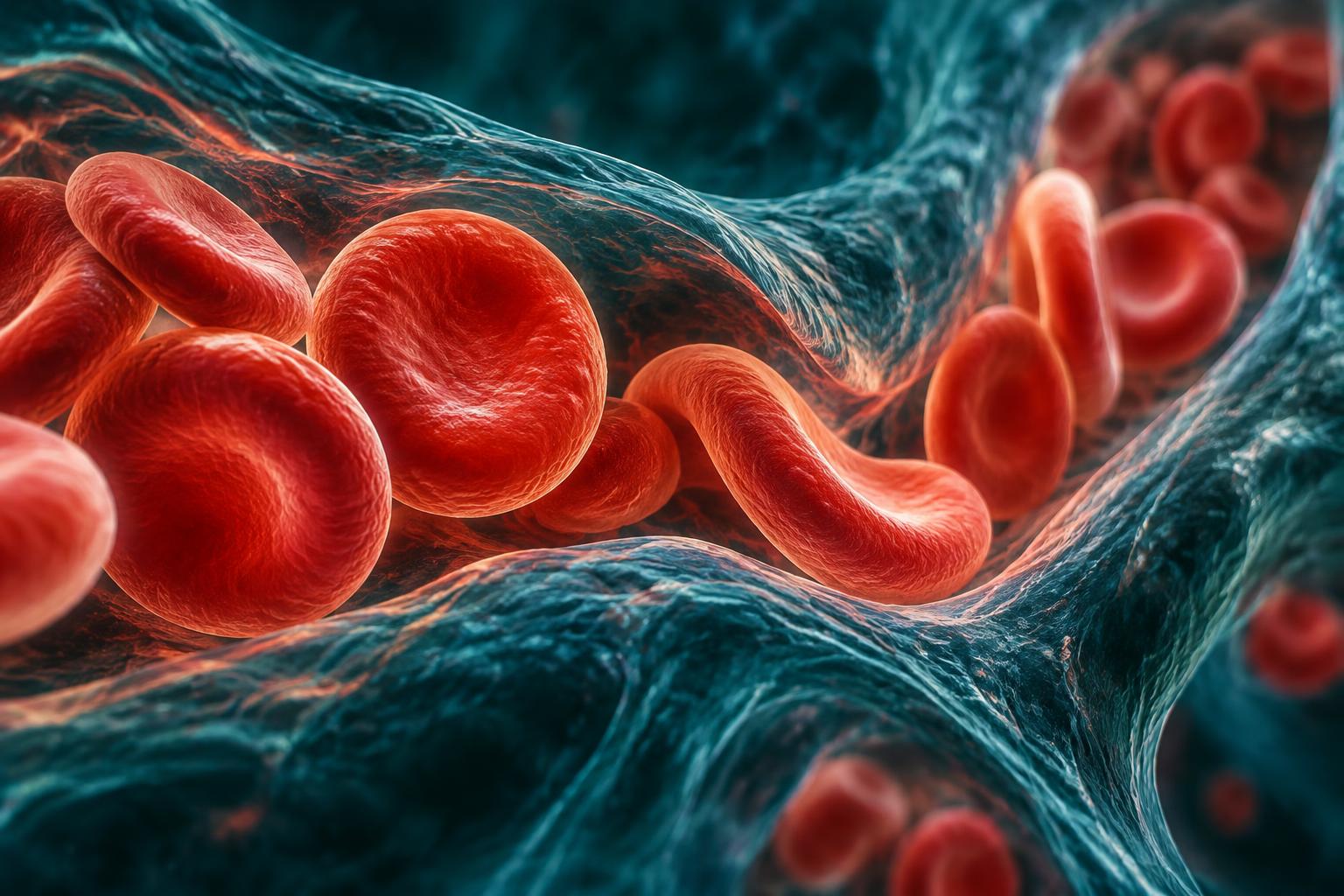
Rouleaux Formation
Blood, Bioelectricity, Microcirculation, and the Environment We Live In
Most of us were taught a pretty simple story about blood. The heart pumps it, red blood cells carry oxygen, and our arteries and veins move everything around the body.
That's true, but it's only a small part of the story.
Blood is alive with activity. It is moving through vessels so small that individual red blood cells sometimes have to change shape just to get through them. Those cells are surrounded by proteins, minerals, gases, hormones, and electrically charged ions. Their movement is influenced by pressure, chemistry, , vascular tone, and even the speed at which the blood itself is flowing.
And red blood cells themselves have electrical properties.
This is where rouleaux formation, or erythrocyte aggregation, becomes really interesting.
What Is Rouleaux Formation?
Under certain conditions, red blood cells begin grouping together in formations that look almost like a stack of coins.
That's called rouleaux.
What interests me isn't simply whether red blood cells ever touch or aggregate. What interests me is why their behavior changes and what that might tell us about the environment they're traveling through.
Red blood cells normally have a negative electrical characteristic at their surface. In simple terms, there is an electrical component helping neighboring cells resist getting too close to one another.
One way scientists describe part of this electrical relationship is zeta potential.
But electrical charge is only one part of the picture. Plasma proteins, , blood viscosity, hydration, the flexibility of the red blood cell, and the actual speed of blood flow all influence how these cells behave.
That's why I don't look at rouleaux as an isolated condition.
I look at it as another window into the environment of the body.
Blood Doesn't Flow Like Water
This is one of my favorite pieces of the science because it completely changes the way we think about circulation.
Blood isn't like water moving through a garden hose.
It is a non-Newtonian fluid, which basically means its thickness and flow characteristics change depending on what's happening to it.
When blood is moving slowly, red blood cells have more opportunity to aggregate. As blood moves faster, the mechanical forces created by that movement—called shear forces—can help separate those cells again.
So blood is constantly adapting.
And then look at what happens when it reaches the smallest vessels.
A typical red blood cell is actually about the same size or larger than the diameter of some capillaries. It has to bend, fold, and deform to make its way through.
Think about that for a second.
Your heart isn't simply pumping a red liquid through your body. It is moving trillions of individual flexible cells through an incredibly complex microscopic vascular network.
That's microcirculation.
And ultimately, that's where the work gets done.
Microcirculation: Where Blood Meets the Body
We spend a lot of time talking about the heart and the large blood vessels because they're easy to understand.
But every cell in your finger, brain, muscle, skin, or liver doesn't have a major artery running directly to it.
The delivery happens downstream through progressively smaller vessels until we reach the microcirculation.
This is where oxygen and nutrients finally have the opportunity to reach tissue and where metabolic products begin moving away.
For that system to work well, a lot has to happen correctly.
The heart has to move the blood. The vessels have to respond. Red blood cells have to remain flexible enough to navigate tiny spaces. Oxygen has to stay attached to while it's being transported and then be released where it's actually needed.
That's why simply saying, "My oxygen saturation is 98%, so my tissues have plenty of oxygen," doesn't tell the entire story.
The oxygen still has somewhere to go.
: Opening the Road
Another important piece is nitric oxide.
is a signaling molecule involved in helping blood vessels relax and regulate their diameter.
The inner lining of our blood vessels—the endothelium—isn't just a passive wall. It's constantly sensing what's happening and responding to the environment.
Blood moving across that lining creates mechanical forces. The endothelium senses those forces and participates in adjusting vascular tone.
As we age, nitric-oxide bioavailability commonly declines. Mitochondrial function can change. -producing capacity can decline. Vascular function changes. and inflammatory activity can increase.
I don't see those as completely unrelated aging processes.
I see a system changing together.
And that makes me ask a different question:
What happens when we intentionally improve the environment that system is operating in?
: We Have to Talk About Energy
stands for adenosine triphosphate.
You don't need to remember the name. Just think of as usable cellular energy.
Your cells need energy to do almost everything.
Your muscles need it. Your nervous system needs it. Cellular repair needs it. Maintaining electrical gradients across cell membranes requires it.
And play a major role in producing it.
This gives us two sides of the equation that I think are incredibly important:
Can we efficiently deliver oxygen and nutrients to the tissue?
And once they arrive:
Can the cells efficiently use them?
That's why circulation and mitochondrial health belong in the same conversation.
CO₂ Is Not Just Waste
This was another major shift in the way I learned to look at physiology.
Most of us grew up thinking oxygen is good and carbon dioxide is the stuff we're trying to get rid of.
CO₂ is much more important than that.
Carbon dioxide helps regulate breathing, blood chemistry, vascular responses, and how readily releases oxygen.
One of the mechanisms involved is called the Bohr effect.
Here's the simple version:
Getting oxygen into the blood is only half the job.
We also have to get oxygen out of the blood and into the tissue.
CO₂ and local chemistry help influence that process.
That's one reason I'm so interested in controlled CO₂ training. We're not simply playing with breath-hold times. We're exploring a regulatory system involving breathing, blood chemistry, vascular response, oxygen delivery, heart rate, and the .
Now Add the Nervous System
Circulation doesn't operate independently of our nervous system either.
If your brain believes you need to run from a threat, your circulation changes.
If you're cold, circulation changes.
If you're exercising, circulation changes.
If you're resting after eating, circulation changes.
The is continually helping determine where resources should go.
Raynaud's phenomenon gives us an easy example. Someone's hands can become painfully cold even though the rest of the body isn't cold.
Their body hasn't suddenly run out of blood.
Something has changed in vascular regulation and peripheral blood flow.
That immediately connects circulation with nervous-system regulation.
And now the conversation becomes much bigger than blood.
Our Electrical Environment
This is another area I want Therapeutic Love to explore much more deeply.
We are electrical organisms living in an electrical environment.
Our heart produces measurable electrical activity. Our nervous system communicates electrochemically. Our cells maintain voltage differences across their membranes. Minerals such as sodium, potassium, calcium, and chloride exist as charged ions and are essential to how the body functions.
And then there's the environment around us.
We've all experienced static electricity.
Walk across carpet and touch a metal object.
Pull certain clothing out of a dryer.
Watch someone's hair stand up when electrical charge accumulates.
Those aren't theories. They're observable electrical phenomena.
So I think it's reasonable to become curious about how our electrical environment interacts with our biology.
Grounding: More Than Bare Feet in the Grass
Grounding is usually presented in a very simple way: take your shoes off and stand on the earth.
I want to look deeper than that.
When the human body makes conductive contact with the earth, its electrical potential relative to the earth can change.
That immediately gives us measurable questions.
What happens to body voltage?
What happens to ?
What happens to peripheral circulation?
What happens to blood viscosity?
What happens to erythrocyte aggregation?
What happens to zeta potential?
And what happens when grounding becomes part of a larger protocol instead of something we're studying completely by itself?
Those are questions I'm interested in exploring.
Hair, Clothing, Shoes, and Static Electricity
Then we have another layer that most people probably never think about.
Different materials interact with electrical charge differently.
Wool can accumulate substantial static charge. Synthetic materials behave differently from natural fibers. Rubber behaves differently from leather. Humidity dramatically changes static electricity.
Shoes can electrically insulate us from the ground or provide varying levels of conductivity.
And hair is clearly capable of interacting with electrostatic fields—we can literally watch it happen.
This leads to one of our working hypotheses:
Does having more hair create a larger interface with the surrounding electrostatic environment, and if it does, is there any measurable effect beyond the surface of the body?
That's exactly the kind of question I like.
We don't have to start with the answer.
We can start with curiosity and figure out what we can actually measure.
Where BEMER Fits Into This
Now we can start bringing our modalities into the conversation.
One of the reasons I'm interested in BEMER is microcirculation.
We're looking at the smallest vessels of the body and the dynamic regulation of blood flow through those vessels.
If we influence microvascular activity, we're changing the environment through which red blood cells are traveling.
Remember what we talked about earlier: blood-flow velocity and shear forces influence erythrocyte behavior.
So instead of reducing BEMER to "this machine charges blood cells," I think there's a much more interesting question:
What happens to the entire microcirculatory environment when we introduce an electromagnetic signal?
Then we measure from there.
Where Fits
Now introduce light.
Red and gives us another way of interacting with biology.
Here we're particularly interested in cellular signaling, , , nitric-oxide-related pathways, local circulation, and tissue response.
Think about how interesting this becomes.
BEMER gives us one input.
Light gives us another.
CO₂ gives us another.
Grounding gives us another.
Movement gives us another.
Breathwork and nervous-system regulation give us another.
We're approaching the same human system from several different directions.
Where HBOT Fits
oxygen changes the oxygen environment again.
Increasing atmospheric pressure can increase the amount of oxygen dissolved in plasma.
But once again, I don't want to stop at:
More oxygen = better.
I want to ask:
Where does that oxygen go?
What is the condition of the microcirculation?
What is happening with CO₂?
What are the doing?
What is happening with ?
What is happening with vascular tone?
What state is the nervous system in?
Because none of these systems operate alone.
This Is Where Therapeutic Love Comes Together
This is really the foundation of what I'm building.
I don't want to look at the human body as a collection of individual problems.
Back pain over here.
Anxiety over there.
Circulation over here.
Sleep somewhere else.
in another category.
The nervous system in another.
That's not how the body experiences itself.
It's one organism.
Circulation affects cellular metabolism.
Respiration affects circulation.
The nervous system affects vascular tone and breathing.
CO₂ affects oxygen delivery.
affects vascular regulation.
Light can influence cellular signaling.
Movement changes circulation.
Our electrical environment interacts with the body.
Our have to turn the resources that arrive into usable energy.
It's all happening at the same time.
The Therapeutic Love Working Hypothesis
Rouleaux formation gives us another place to look.
Not because I believe rouleaux alone explains everything happening in the human body.
It doesn't need to.
I'm interested in what it may tell us about the environment.
Why are the red blood cells behaving the way they're behaving?
What's happening with their surface properties?
What's happening with blood viscosity?
What's happening with ?
What's happening with microcirculation?
What's happening with ?
What's happening with CO₂?
What's happening with oxygen delivery?
What's happening with ?
What's happening with autonomic regulation?
And then comes the question I'm most interested in:
What changes when we intentionally change the environment?
That's where we can start looking at BEMER, grounding, CO₂ training, , HBOT, movement, breathwork, stimulation, meditation, and nervous-system regulation—not as completely separate therapies, but as different inputs into the same biological system.
Becoming the Experiment
This is where I think wellness gets really interesting.
Instead of assuming, we can observe.
Instead of chasing every symptom independently, we can start looking at patterns.
Measure .
Measure blood pressure.
Measure peripheral temperature.
Measure oxygen saturation and CO₂ where appropriate.
Look at inflammatory markers.
Study microcirculation.
Study erythrocyte aggregation.
Study zeta potential when we have the ability.
Change one variable and observe.
Combine variables thoughtfully and observe again.
Become the experiment—from the inside.
Because the question underneath all of this isn't really about rouleaux.
It's much bigger:
What conditions does the human body need in order to regulate itself the way it was designed to?
That's the question behind Therapeutic Love.
Not simply treating the symptom.
Not separating the human being into dozens of disconnected systems.
But learning the operating system well enough to understand how circulation, charge, light, oxygen, CO₂, cellular energy, movement, environment, and the nervous system communicate with one another.
The deeper I get into this work, the more I come back to the same idea:
The body isn't a collection of parts that forgot how to work. It is an interconnected system continually adapting to the information and environment we give it.
And that gives us an incredible place to begin.
Important Note
This article is educational and presents an evolving Therapeutic Love working hypothesis, not medical advice, diagnosis, or treatment. Rouleaux can occur normally, and a blood image alone should not be used to diagnose disease or explain symptoms. Traditional knowledge, practitioner observations, and lived experience give us reasons to explore possible relationships among grounding, electrostatic exposure, zeta potential, BEMER, light, CO₂ practices, stimulation, and rouleaux. Direct clinical measurement has not yet answered every part of that framework, so I present these relationships as questions to investigate rather than guaranteed treatment effects. Each modality has different evidence, contraindications, and safety considerations. Explore health concerns and device use with qualified clinicians and follow manufacturer guidance.